


Every parent gets it: Decoding your baby’s sleep quality can feel like solving a mystery in the dark. Some nights they sleep for long, blissful stretches, others are full of unpredictable wake-ups. Bedtime goes smoothly for a week, and then travel, sudden growth spurts, or daylight savings derails consistency.
You’re often left wondering:
“How long was she actually awake last night?”
“Are his night wakings normal at this stage?”
“She slept for a long time… but was it quality sleep?”
We’ve been there—and we built a new feature to help.
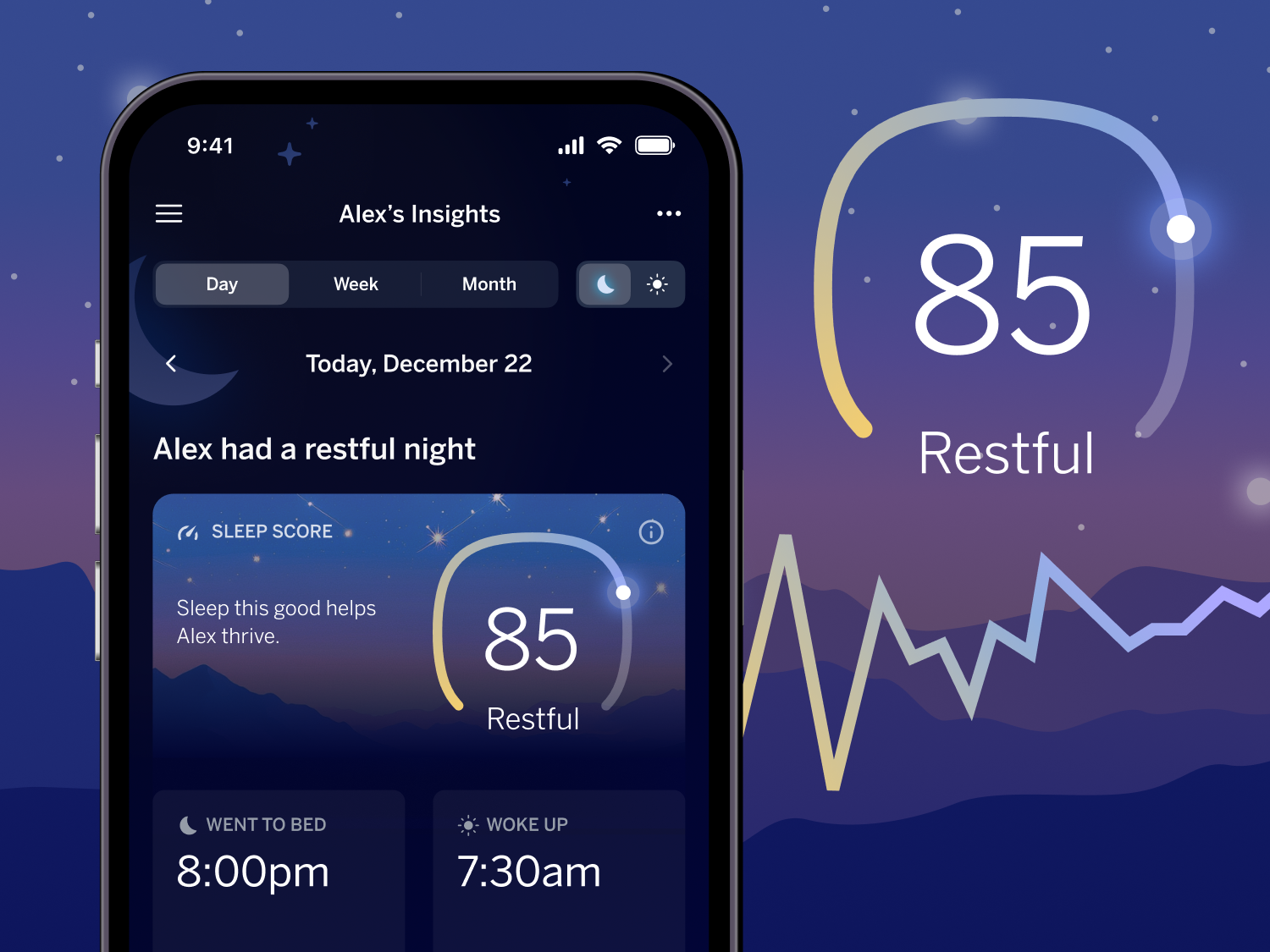
Meet Sleep Score: The first AI-driven, science-backed sleep score designed specifically for babies.
Sleep Score sorts through the complexity of your baby’s night and translates it into one metric that shows how well they slept, so you can track their sleep quality over time.
And as your baby grows, Sleep Score automatically adjusts to account for age, offering insights that are developmentally appropriate. Not only are you getting the full picture of each sleep session, but you’re also gaining clarity that evolves with your family.
What is Sleep Score?
Think of Sleep Score as your baby’s morning sleep summary, distilled into a simple number (up to 100).
If charts, graphs, and metrics aren’t your thing, Sleep Score is the one number you can turn to for reliable insight into your baby’s rest. Behind the scenes, it’s powered by the same advanced computer vision technology Nanit has used for years to analyze sleep, combined with guidance from Nanit Lab experts and our Scientific Advisory Board.
In short, we’ve cracked the code on delivering sleep science and world-class technology in the most parent-friendly way possible.
How Sleep Score works
Every night, Nanit auto-captures (seriously, you don’t have to lift a finger) incredibly detailed information about your baby’s sleep quality. When your morning begins, all that complexity is transformed into a Sleep Score.
Because babies change constantly, the same combination of sleep factors can look very different for a 2-month-old versus a 12-month-old. That’s why Sleep Score was designed to adapt at every stage of development.
Keep in mind, “good sleep” isn’t defined by hours alone. Sleep Score is built on four key components that sleep scientists consider essential for healthy rest:
1. Sleep Duration
How long your baby slept across the entire night, capturing actual sleep, not just time spent in the crib.
2. Sleep Timing
How aligned your baby’s bedtime and morning wake-up are with biologically healthy rhythms for their age.
3. Sleep Continuity
How smoothly your baby slept, considering both the number of night awakenings and the total time awake between sleep bouts.
4. Parent Visits
How often you attended to your child, offering insight into how much support your baby needed to settle throughout the night—you can’t track that with any other baby monitor.
Each factor is carefully weighted and combined to create one intuitive number that represents the night as a whole.
Ready to see your baby’s Sleep Score?
Sleep Score begins rolling out to Nanit subscribers starting December 16, 2025. Your app will update automatically, no extra setup required.
Once it appears on your dashboard, you’ll wake up to a new Sleep Score each morning to see how the night went, how it compares to your baby’s typical range, and what factors shaped it.
You’ll start noticing patterns within just a few days. The more sleep you track, the more powerful the tool becomes, paving the way for a clearer understanding of your baby’s sleep health.
Here’s to restful nights, calmer mornings, and quality sleep for the whole family. Sweeter dreams await.
Nanit Home is Here
Halfway There! Your Guide to 20 Weeks Pregnant